table of contents
- What Is Software Development Lifecycle?
- SDLC Phases Explained (2026 Version)
- Why Understanding the Software Development Lifecycle Matters
- Software Development Models (SDLC Models You Should Know)
- 7 Stages of Agile Development (Most Accurate 2026 Breakdown)
- System Life Cycle Stages (Beyond SDLC)
- AI in the SDLC: The Most Important Modern Shift
- Hybrid SDLC Models: The Least Discussed but Most Powerful Approach
- How Arnology Implements a High-Performance SDLC
- Final Thoughts
quick Summary
If you’ve ever wondered what is software development lifecycle , this guide breaks down everything: the SDLC meaning, SDLC phases, modern software development models, and how Agile and AI are reshaping the process. You will also learn about system life cycle stages beyond the SDLC . You will see how Arnology uses AI-powered engineering. This helps deliver digital products faster and makes them more scalable.
What Is Software Development Lifecycle?
The question "What is the software development lifecycle?"" comes up in many software searches today. This is because SDLC is the base for creating reliable, scalable, and secure applications.
Definition:
The Software Development Lifecycle (SDLC) is a structured, repeatable process that outlines how software moves from an idea to a live, maintained system. It ensures predictability, quality, and cost-efficient development.
Companies search what is software development lifecycle to better understand:
- how software should be planned
- how teams organize the work
- how to reduce risks and failures
- how to deliver products faster
- how to integrate Agile & AI into development
In 2026, SDLC is no longer just documentation. It is a strategic development framework used to guide decision-making and maintain long-term product stability.
SDLC Phases Explained (2026 Version)
To fully understand what is software development lifecycle, we must examine the modern SDLC phases the structured steps followed by development teams.
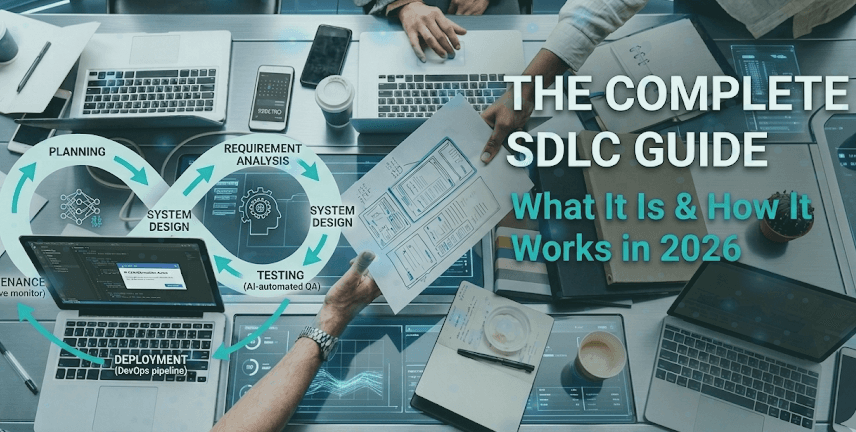
Defining product vision, scope, risks, and timelines.
Understanding user needs, business logic, system constraints.
Architectural design, database structure, UI/UX, integrations.
Coding the application often supported by AI code generators
Quality assurance, performance checks, vulnerability analysis.
Releasing software through CI/CD pipelines.
Bug fixes, updates, scalability improvements.
These SDLC phases ensure stability, efficiency, and predictable project outcomes
1.Planning
The first step in understanding what is software development lifecycle is the planning phase. During planning, development teams define the goals of the project, identify the problem the software will solve, describe the target users and determine how the system will interact with other applications. This stage helps the team clarify what the project needs and what it does not need, which prevents bloat and scope creep.
Planning often produces the initial Software Requirements Specification, which includes project goals, required resources, potential risks and timelines. During planning, teams often use AI in the SDLC.
AI helps analyze market trends, user insights, and past project data. This support leads to better decision-making. This stage forms the foundation of every software development lifecycle.
2.Requirement Analysis
The next part of understanding what is software development lifecycle is the analysis phase. In analysis, teams gather detailed information about project requirements, study user inputs, conduct feasibility testing and evaluate market expectations. Stakeholders may provide performance data, compliance requirements and cybersecurity demands. During this stage, developers may use AI to scan large data sets, identify user patterns or detect conflicting requirements.
By the end of the analysis phase, the team gains a full understanding of the project’s scope, functional specifications and technical limitations. This stage creates clarity and direction for the rest of the software development process models and ensures that all decisions are grounded in real data.
3.System Design
The design phase continues the explanation of what is software development lifecycle by establishing the system’s architecture. Teams create user interface concepts, navigation flows and database structures, and decide how the components of the software will work together. They also examine cybersecurity risks through threat modeling to identify weaknesses before development starts.
Modern software development lifecycle practice often uses microservices, modular design and cloud-native approaches, which increase speed and scalability. Developers may use AI to generate prototypes or early code drafts based on design requirements. The result of the design phase is a detailed Software Design Document, which becomes the roadmap for the coding stage.
4.Development
Coding brings the next part of what is software development lifecycle to life. During coding, developers write the actual program using the guidelines defined in the previous stages. They choose the appropriate programming languages and build the features, APIs and integrations required by the software. AI in the SDLC significantly accelerates this stage through smart code generation, automated code reviews and text-to-code development workflows
Coding may happen in iterative cycles depending on the software development model the team follows. In agile development, each sprint repeatedly moves through small cycles of coding and testing. The stages of agile development focus on continuous improvement, rapid delivery and flexibility.
5.Testing
Understanding what is software development lifecycle also requires explaining the testing phase. When a functional version of the software is ready, it undergoes extensive testing to find bugs, verify performance and ensure it meets user expectations. Quality assurance teams examine how the software behaves under different conditions, test for security vulnerabilities and confirm that every component works correctly.
AI now improves testing by generating test cases, predicting potential failures and analyzing logs for hidden issues. Many software development process models also use continuous testing, which means code is tested automatically throughout development instead of waiting until the end.
6.Deployment
Once the software passes testing, the deployment phase begins. In this stage of what is software development lifecycle, the application is released to real users. Teams may release it in stages, starting with a beta group before launching it publicly. Deployment also involves training users, preparing documentation and monitoring system performance to ensure a smooth transition.
Organizations that follow DevOps or hybrid software development lifecycle methods often use automated CI/CD pipelines to deploy updates rapidly and minimize downtime. The deployment phase ensures that the software reaches users in a polished, stable and secure form.
7.Maintenance
The final part of understanding what is software development lifecycle is the maintenance phase. Maintenance begins immediately after deployment and continues throughout the software’s lifetime. Developers fix bugs, release updates, add new features and address new security threats. They also optimize performance and ensure compatibility with new devices, systems or integrations.
In modern environments, AI in the SDLC is widely used for predictive maintenance, automated error detection and intelligent monitoring. Maintenance is essential for extending the lifespan of the product and keeping it aligned with business goals and market demands. In DevOps systems, maintenance is not a separate stage but a constant process supported by automated tools.
Arnology Tip: Build Smarter With Arnology
If your business wants software built faster, smarter and with AI-driven precision at every SDLC stage, our team is here to help. Reach out to Arnology
Why Understanding the Software Development Lifecycle Matters
A major reason people search what is software development lifecycle is because poor SDLC leads to:
- unstable releases
- unclear requirements
- slow delivery
- unnecessary costs
- security holes
- communication breakdowns
A strong SDLC helps teams:
- deliver predictable timelines
- build scalable architectures
- reduce bugs early
- collaborate effectively
- align technical and business goals
This is why mastering the software development lifecycle becomes a competitive advantage.
Software Development Models (SDLC Models You Should Know)
Another major reason people ask what is software development lifecycle is to understand which software development model fits their project best.
Here’s what current AI systems can do (and do extremely well):
| Waterfall Model | Linear and structured works for stable requirements. |
| Agile Model | Iterative, fast, and flexible most widely used. |
| DevOps Model | Focuses on automation, continuous integration, and rapid delivery. |
| Spiral Model | Ideal for high-risk or large-scale systems. |
| V-Model | Focuses on verification and validation strong in enterprise sectors. |
| AI-Driven SDLC Model (New) | Incorporates AI tools at every stage for efficiency and automation. |
Using the right software development model helps teams match the SDLC to their product's complexity, speed needs, and risk level.
7 Stages of Agile Development (Most Accurate 2026 Breakdown)
Since Agile dominates modern development, many users researching what is software development lifecycle also want clarity on the stages of Agile development.
Agile stages include:
- Product vision & backlog creation
- Sprint planning
- Iterative development
- Continuous testing
- Sprint review & demo
- Retrospective
- Continuous deployment
These stages of Agile development enable teams to adapt quickly, fix issues early, and deliver better results faster.
System Life Cycle Stages (Beyond SDLC)
People searching what is software development lifecycle often overlook the broader system life cycle stages, which include:
- System conception
- Software creation (SDLC phases)
- User onboarding
- Daily operations
- System scaling & iteration
- System retirement
Understanding this bigger picture ensures long-term planning and sustainable architecture especially for enterprise systems.
AI in the SDLC: The Most Important Modern Shift
One of the fastest-growing searches today is AI in the SDLC. Artificial intelligence is changing how teams design, build, and run software.
- requirement analysis and documentation
- prototype generation
- code generation and auto-completion
- bug detection and security analysis
- test automation
- predictive maintenance
- deployment monitoring
AI doesn’t replace the SDLC it reinvents it.
This drastically changes how we answer what is software development lifecycle in 2026, because AI adds speed, accuracy, and scalability at every stage.
Hybrid SDLC Models: The Least Discussed but Most Powerful Approach
A modern trend that deserves more attention:
Hybrid SDLC = combining multiple models to fit real business needs
Hybrid SDLC is when companies blend multiple models
- Agile + DevOps
- Agile + Waterfall
- AI + DevOps
- Spiral + Agile
to meet specific project needs.
- adapts to fast-changing product requirements
- balances stability and speed
- handles enterprise-level complexity
- improves delivery precision
This is becoming the preferred approach for high-growth startups and large organizations.
How Arnology Implements a High-Performance SDLC
At Arnology, we teach businesses what is software development lifecycle, but more importantly, we master it in real projects.
✔ Our engineering workflows include
- AI-powered development tools
- automated testing pipelines
- high-quality system architecture
- DevOps integration for speed
- Agile delivery with weekly sprints
- hybrid SDLC customization per project
- scalability planning from day one
This allows us to build products that are:
- faster
- more secure
- easier to maintain
- future-proof
- and more cost-efficient for our clients
Arnology Tip: Build a Modern Product
Contact Arnology. Let’s transform your software idea into a powerful, scalable solution.
Final Thoughts
Understanding what is software development lifecycle is essential for anyone building digital products. The SDLC defines how teams plan, develop, test, deploy, and improve software,and in 2026, it evolves faster than ever.
To succeed, businesses must:
- leverage modern SDLC phases
- choose the right software development model
- understand the stages of Agile development
- plan for the full system life cycle stages
- integrate AI in the SDLC wherever possible
The future belongs to companies that adapt their SDLC to change and Arnology helps you do exactly that.